
Circadian Rhythm

The transition from wakefulness to sleep is not instantaneous. It is a gradient — a biological progression that takes anywhere from a few minutes to over half an hour depending on the conditions that preceded it. What happens in the two hours before lights-out is, in the view of most published sleep research, as consequential as what happens during the night itself.
In the documented literature on sleep onset, the concept of a "wind-down window" — a defined period of decreasing stimulation before the intended sleep time — appears with notable consistency. Studies examining sleep onset latency (the time elapsed between lights-out and the first measurable sleep stage) have found correlations between pre-sleep routine structure and reduced onset times.
The mechanism is not mysterious. The nervous system, operating across the day under relatively high stimulation conditions — screens, ambient noise, social engagement, task completion — requires a documented deceleration period before the transition to rest becomes efficient. Without such a period, the system continues running at a higher activation state at the point when rest is attempted.
What a structured wind-down sequence accomplishes is to begin signalling, across multiple sensory channels simultaneously, that the activity period is ending. This involves light levels, ambient sound, temperature, and cognitive load — all being reduced or stabilised in a deliberate sequence.
Among the environmental variables associated with evening routines, light exposure carries the most extensively documented relationship to sleep quality. The spectral composition of light — specifically the proportion of short-wavelength (blue) light — has been identified in published research as a significant input to melatonin regulation, the circadian factor centrally involved in the body's rest-onset signalling.
Practically, this finding has led to a number of recommended practices in published sleep-hygiene literature: the dimming of overhead lighting after a fixed evening hour, the avoidance of high-brightness screen use within 60-90 minutes of the target sleep time, and the introduction of warm-spectrum ambient lighting (candles, salt lamps, or low-wattage warm-tone bulbs) as a transitional signal.
The key observation — repeated across multiple independent studies — is that the effect is cumulative and rhythmic rather than immediate. A single evening of reduced light exposure does not reliably produce a faster sleep onset. The benefit accumulates over a period of consistent practice, with most study participants showing measurable changes in onset latency after 7 to 14 days of adherence.
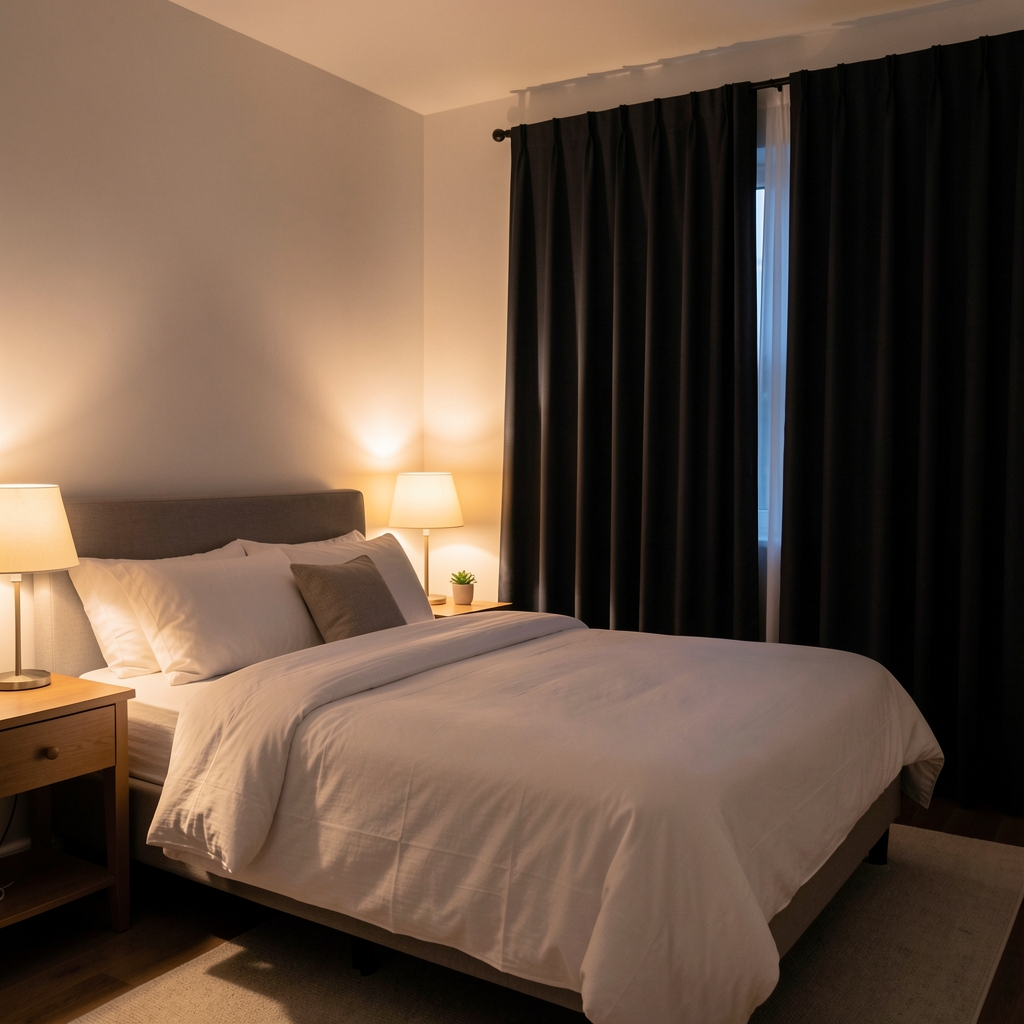
Core body temperature follows a circadian pattern. It peaks in the late afternoon — typically around 16:00 to 18:00 — and begins a gradual decline as the evening progresses, continuing to drop through the night and reaching its lowest point in the early hours of the morning. This decline is not incidental: it is part of the rest-onset sequence.
Research into temperature manipulation and sleep has identified that facilitating the body's natural cooling process in the evening can both shorten sleep onset latency and increase the proportion of deep sleep stages in the first half of the night. The practical applications most documented in published literature include: a warm bath or shower taken 60 to 90 minutes before the target sleep time (which accelerates the post-bath surface cooling), bedroom temperature set to the range of 16–19°C, and bedding weight adjusted to avoid re-warming during the night.
The shower or bath finding is counterintuitive to many practitioners who assume that cooling before bed means avoiding warmth. The mechanism is the opposite: immersion in warm water raises the body's surface temperature, which then dissipates rapidly after exiting, producing a faster and deeper post-immersion cooling effect than would occur passively.
Sleep onset is not purely physiological. Cognitive activation — mental rehearsal, problem-solving, planning, and unresolved task monitoring — is a well-documented obstacle to efficient sleep onset. The term most frequently used in published research is "pre-sleep cognitive arousal", referring to the presence of high-activation thought patterns at the point when rest is attempted.
Documented practices that address cognitive arousal before sleep include several broad categories. The first is a transfer of unfinished tasks: a brief written record of pending items — a to-do list for the following day — has been associated in controlled studies with faster sleep onset, the likely mechanism being that externalising the items reduces the working-memory load maintaining them.
A second category involves engagement with low-stimulation reading: physical books (as opposed to screen-based reading) on non-arousing subject matter. A third involves structured breathing sequences — extended exhalation relative to inhalation (typically a 4:6 or 4:7 ratio) which activates the parasympathetic arm of the nervous system and is associated with reduced heart rate and lowered physiological arousal.
Across the published literature on sleep hygiene, one observation recurs with greater frequency than any specific practice: the timing consistency of the routine matters as much as its content. A wind-down sequence performed at a highly variable time each night — sometimes at 21:00, sometimes at midnight, adjusted based on social or work demands — produces noticeably smaller benefits than the same sequence performed at a stable time.
The circadian system operates on a predictive basis. It begins preparing the body for sleep — initiating melatonin release, beginning core temperature descent, shifting attentional systems toward lower alertness — before the sleep attempt begins. This preparation is not triggered by the act of going to bed. It is triggered by internal and external cues that have become associated with that time through consistent repetition.
The practical implication is that a wind-down routine, however well-designed in its individual components, delivers its full potential only when performed at a stable time each night. Practitioners who maintain consistent schedules for 21 or more consecutive days typically report the transition becoming noticeably more automatic — the sequence itself becomes a signal that accelerates the onset of the transition it precedes.
Articles published on Belsoran Notebook are editorial in nature and reflect the writers' observations on everyday wellness practices. The content is not intended as professional advice, nor as guidance for the management of any specific condition. Readers with specific concerns about their daily routines are encouraged to speak with a qualified wellness professional.

Eleanor Whitfield is a contributing editor at Belsoran Notebook with a background in wellness practice writing and sleep-research journalism. She has covered rest and recovery practices for independent editorial publications for six years.
More from Eleanor Whitfield →